1956
From January to early May Mailer writes seventeen weekly "Quickly: A Column for Slow Readers" columns (56.1–56.17) for The Village Voice, then resigns over editorial differences with his partners — closing with a defense of Samuel Beckett's Waiting for Godot. In May the novella "The Man Who Studied Yoga" (56.25) appears. The Mailers summer in Europe (Spain, Germany — touring Buchenwald — Italy, and Paris, where Jean Malaquais introduces them to James Baldwin); in the fall they move to Bridgewater, Connecticut, near William Styron. Mailer takes up boxing under Al Morales and builds an orgone box on Wilhelm Reich's pattern.
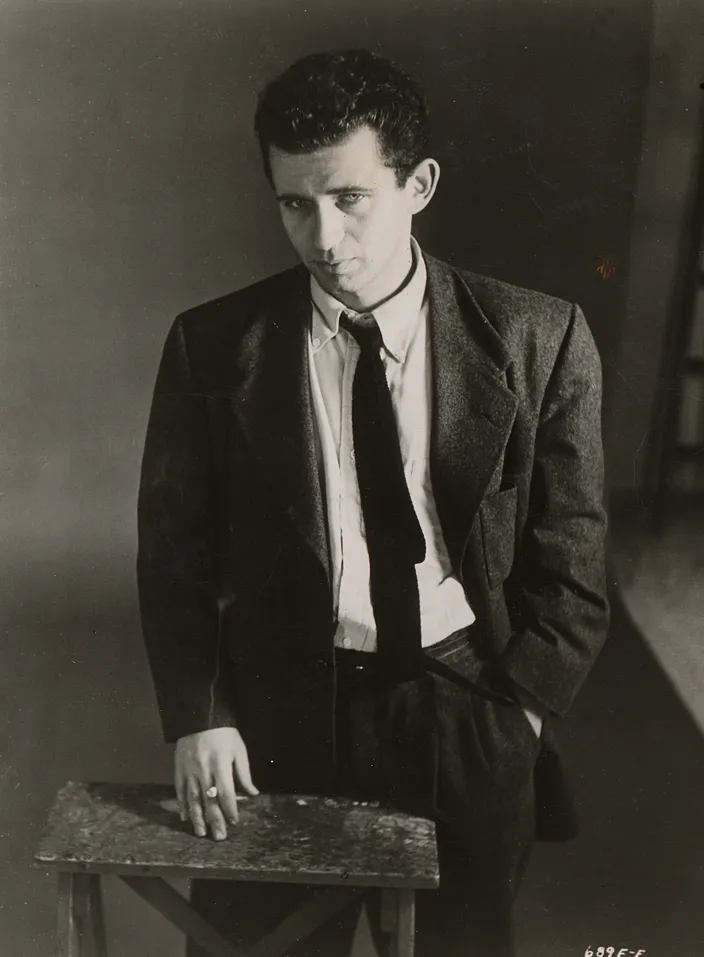
January–May — the “Quickly” column
From 11 January to 2 May Mailer publishes seventeen weekly columns, “Quickly: A Column for Slow Readers” (56.1–56.17), in The Village Voice — the paper he had co-founded the previous October. Edwin Fancher introduces the column on 4 January. The run moves from media criticism and parody through a stretch on psychoanalysis, a mock campaign nominating Ernest Hemingway for President, a eulogy for Robert Lindner (56.9), and — in the final weeks — the first stirrings of “Hip” that will become “The White Negro.” Mailer then resigns from active participation over editorial differences with his partners, ending with a defense of Samuel Beckett’s Waiting for Godot (56.17) and a follow-up paid notice (56.26).
February — Lindner’s death
February — Lindner dies of heart disease at forty-one, some six weeks after dictating a last note to Mailer from Johns Hopkins Hospital: “There is nothing more to say, except love.” When Lindner told him on the phone that he was going to die and broke down, Mailer felt only coldness and anger, as he told J. Michael Lennon in a 2007 interview. The death itself was “one of the great blows of my life” (qtd. in S. Mailer 2024, pp. 245–46). His “Quickly” column of 7 March (56.9) is a eulogy, saying that Lindner “was so good a friend that I simply have no heart to write about him now.”
May — “The Man Who Studied Yoga”
In early May Ballantine publishes “The Man Who Studied Yoga” (56.25) in New Short Novels 2 — a novella Mailer conceived as the preface to a projected cycle of eight interlocking novels, of which only The Deer Park was ever published.
Summer — Europe
The Mailers spend the summer in Europe, visiting Spain, Germany (where they tour Buchenwald), Italy, and Paris, where Jean Malaquais introduces them to James Baldwin.
Fall — Bridgewater, boxing, and the orgone box
In the fall the Mailers move to Bridgewater, Connecticut, near the home of William Styron; they also spend time with John W. Aldridge, who becomes one of Mailer’s most consistent critical supporters. Mailer begins learning to box from his father-in-law, Al Morales, a former professional boxer, and builds an orgone box on the pattern devised by Wilhelm Reich, whose theories influence him.
Related pages
- 1955 | 1957
- Quickly: A Column for Slow Readers | The Man Who Studied Yoga | A Public Notice by Norman Mailer
- The Village Voice | Bridgewater, Connecticut | James Baldwin | Al Morales | Robert Lindner | Ballantine Books
- Quickly (11 January 1956) (56.1) | Quickly (2 May 1956) (56.17) | Quickly (7 March 1956) (56.9)
Referenced by 36
Works
- A Public Notice by Norman Mailer
- Quickly (1 February 1956)
- Quickly (11 April 1956)
- Quickly (11 January 1956)
- Quickly (14 March 1956)
- Quickly (15 February 1956)
- Quickly (18 April 1956)
- Quickly (18 January 1956)
- Quickly (2 May 1956)
- Quickly (21 March 1956)
- Quickly (22 February 1956)
- Quickly (25 April 1956)
- Quickly (25 January 1956)
- Quickly (28 March 1956)
- Quickly (29 February 1956)
- Quickly (4 April 1956)
- Quickly (7 March 1956)
- Quickly (8 February 1956)
- Quickly: A Column for Slow Readers
- The Man Who Studied Yoga
Letters
- Reply to a Village Voice Letter (Joe Jensen)
- Reply to a Village Voice Letter (Kenneth J. Schmidt)
- Reply to a Village Voice Letter (Kenneth J. Schmidt)
- Reply to Village Voice Letters (1 February 1956)
- Reply to Village Voice Letters (22 February 1956)
- Reply to Village Voice Letters (25 April 1956)
- Reply to Village Voice Letters (25 January 1956)