Advertisements for Myself
Mailer's great omnibus — a 532-page miscellany gathering his stories, essays, columns, interviews, poems, and fragments, stitched together by the italicized first-person "advertisements" that give the book its title and its self-mythologizing method. Published by Putnam's on 6 November 1959, it relaunched Mailer's reputation after the lean middle 1950s and collected the decade's key pieces — "The White Negro," "The Man Who Studied Yoga," and "The Mind of an Outlaw" among them.
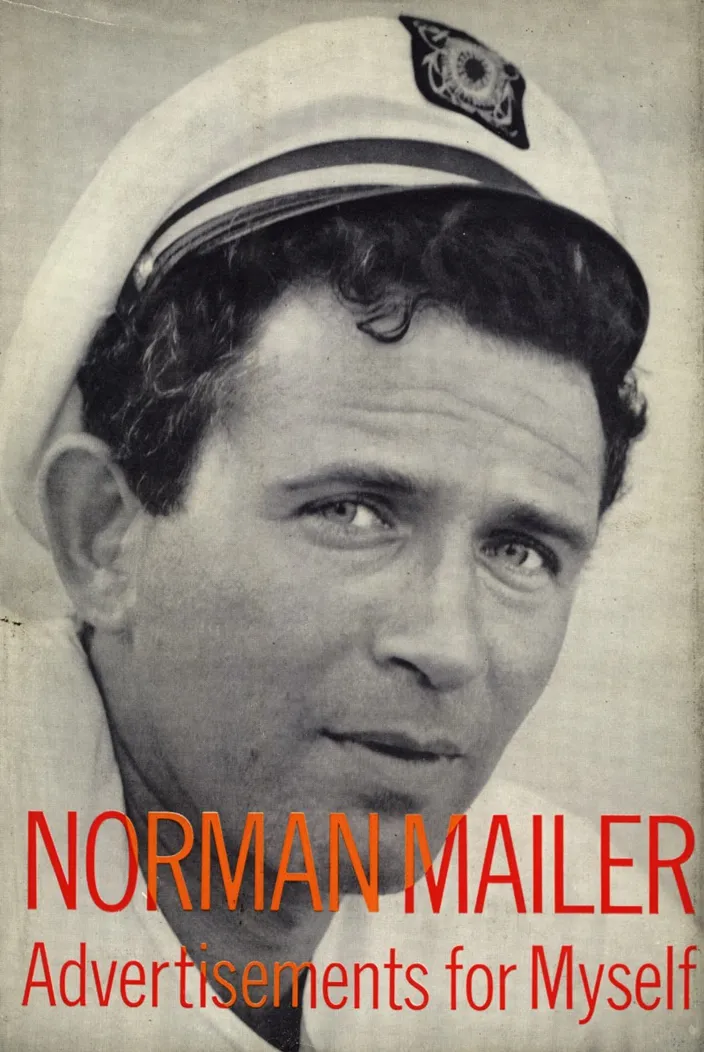
Advertisements for Myself. New York: Putnam’s, 6 November 1959; London: André Deutsch, 29 September 1961. Miscellany, 532 pp., $5. The original working title was “The Hip and the Square: A Miscellany”.
The British Deutsch edition dropped, on legal advice, the second part of “The Time of Her Time” — twenty of twenty-six pages. Mailer’s 400-word polemical postscript (61.15) names the censorship and challenges British writers to fight it. The full text was restored only in the 1968 Panther softcover.
Dedication: “I dedicate this book to the memory of Anne Mailer Kessler (1889–1958) and to David Kessler and to my father Isaac Barnett (‘Barney’) Mailer.”
The “advertisements”
The book’s connective tissue is a sequence of italicized autobiographical “advertisements” in which Mailer frames, defends, and second-guesses the collected pieces — the device that makes the miscellany a single self-portrait rather than a gathering of leftovers. Mailer later reflected (76.14):
So Advertisements became the book in which I tried to separate my legitimate spiritual bile from my self-pity, and maybe it was the hardest continuing task I had yet set myself. What aggravated every problem was that I was also trying to give up smoking, and the advertisements in this book, printed in italics, are testimony to the different way I was now obliged to use language.
What it collects
Among the major pieces collected (often revised, with new prefaces) are “The White Negro” (57.1), “The Man Who Studied Yoga” (56.25), “Advertisements for Myself on the Way Out” (58.4), “Quick and Expensive Comments on the Talent in the Room” (59.10), the “Fourth Advertisement for Myself: The Last Draft of The Deer Park” (a revision of “The Mind of an Outlaw,” 59.14), scenes from the Deer Park play, and much of the short fiction and the Quickly columns. Portions appeared in periodicals around the book’s release (e.g., 59.10, 59.12, 59.14) — a heralding tactic Mailer used for most of his major books from 1959 on.
Reprints
Rpt: republished with a new Mailer preface (New York: Berkley, December 1976 = 76.16); the preface reappears (minus its first paragraph) as “An Advertisement Advertised” in 82.16. All of the short stories appear in 67.11 and 82.19; several selections appear in 98.7 and 13.1.
Related pages
- 1959 | G. P. Putnam's Sons
- The White Negro | The Man Who Studied Yoga | The Mind of an Outlaw | The Deer Park | Hipster
- Untitled postscript to 'The Time of Her Time' (61.15) | Preface to The Deer Park (76.14) | Advertisements for Myself on the Way Out (58.4) | Quick and Expensive Comments on the Talent in the Room (59.10) | Sentiments Larger than Work (59.12) | Preface to Advertisements for Myself (76.16) | The Short Fiction of Norman Mailer (67.11) | The Essential Mailer (82.19) | The Time of Our Time (98.7)
Criticism 17
Reviews
- Tynan, Kenneth. “Review of Advertisements for Myself.” Village Voice, 1959-11-18. positiveregister
- Kazin, Alfred. “How Good is Norman Mailer?” Reporter, 1959-11-26, 40–41. positiveregister
- Vidal, Gore. “The Norman Mailer Syndrome.” Nation, 1960-01-02, 13–16. mixedregister
- Davis, Robert Gorham. “Norman Mailer and the Trap of Egotism.” Story, 1960, 117–119. negativeregister
- Krim, Seymour. “A Hungry Mental Lion.” Evergreen Review, 1960, 175–185. positiveregister
- Steiner, George. “Naked but Not Dead.” Encounter, 1961-12, 67–70. positiveregister
Essays, chapters, and books
- Baldwin, James. “The Black Boy Looks at the White Boy.” Esquire, 1961-05, 102–06. register
- Leeds, Barry H. The Structured Vision of Norman Mailer. New York: NYU Press, 1969. register
- Solotaroff, Robert. “The Formulation Expanded: Mailer’s Existentialism.” Down Mailer's Way, University of Illinois Press, 1973, 89–99. register
- Adams, Laura. “Phase One: Advertisements for Myself.” Existential Battles: The Growth of Norman Mailer, Ohio University Press, 1976, 27–66. register
- Ehrlich, Robert. Norman Mailer: The Radical as Hipster. Metuchen, NJ: Scarecrow Press, 1978, 3–19. register
- Lounsberry, Barbara. “Health as Metaphor: Advertisements for Myself.” The Art of Fact: Contemporary Artists of Nonfiction, Greenwood Press, 1990, 141–152. register
- Schaub, Thomas Hill. “Rebel without a Cause: Mailer’s White Negro and Consensus Liberalism.” American Fiction in the Cold War, University of Wisconsin Press, 1991, 137–152. register
- Castronovo, David. “Norman Mailer as Midcentury Advertisement.” New England Review, 2004. register
- Justice, Hilary K. “Authorship and Alienation in Death in the Afternoon and Advertisements for Myself.” The Mailer Review, 2010. register
- Stubin, Enid. “'Don't go away feeling unequal': 'The Time of Her Time' and Mailer's Conciliatory Impulse.” The Mailer Review, 2016. register
- Giardina, Anthony. “Fighting for One's Fiction: How Norman Mailer Taught Me to Defend My Plots.” Literary Hub, 2025-04-02. register
Referenced by 106
Works
- 'Yes, I Misbehaved Sometimes'
- "The Naked and the Dead" (advance excerpt)
- A Calculus at Heaven
- A Selection from the Short Fiction of Norman Mailer
- Advertisements for Myself on the Way Out
- All over America The Deer Park is Getting Nothing but Raves
- An Eye on Picasso
- An Intimate Interview with Norman Mailer
- Barbary Shore
- Buddies, or the Hole in the Summit
- Cannibals and Christians
- David Riesman Reconsidered
- Eminent Jews: Bernstein, Brooks, Friedan, Mailer
- Ernest Hemingway's Letter to Norman Mailer, 12 August 1959
- Excerpts from 'The Deer Park'
- Existentialism, Violent Liberation, and Racialized Masculinities: Norman Mailer’s “The White Negro” and An American Dream
- Fighting for One's Fiction: How Norman Mailer Taught Me to Defend My Plots
- From Surplus Value to the Mass-Media
- Great in the Hay
- Hip, Hell, and the Navigator
- In the Ring with Mailer
- It
- Life-View
- Lipton's
- Lipton's, A Marijuana Journal
- Living Like Heroes
- Mailer, Norman
- Maybe Next Year
- Nobody Could Sleep
- Norman Mailer and the Cutting Edge of Style
- Norman Mailer at 100: Conversations, Correlations, Confrontations
- Norman Mailer Speaks His Mind
- Norman Mailer: 'The Time of Her Time'
- Our Country and Our Culture: A Symposium
- Peter Underwood Meets Norman Mailer
- Pierrot
- Preface to Advertisements for Myself
- Preface to The Deer Park
- Quick and Expensive Comments on the Talent in the Room
- Quickly (1 February 1956)
- Quickly (11 January 1956)
- Quickly (14 March 1956)
- Quickly (15 February 1956)
- Quickly (18 January 1956)
- Quickly (2 May 1956)
- Quickly (21 March 1956)
- Quickly (25 January 1956)
- Quickly (28 March 1956)
- Quickly (29 February 1956)
- Quickly (4 April 1956)
- Quickly (7 March 1956)
- Quickly (8 February 1956)
- Quickly: A Column for Slow Readers
- Reflections on Hipsterism
- Right Shoe on Left Foot
- Saint and Psychopath
- Scenes from 'The Deer Park'
- Sentiments Larger than Work
- Speaking of Peace: An Edited Report of the Cultural and Scientific Conference for World Peace
- Statement for Class Record
- The Dead Gook
- The Deer Park
- The Deer Park: A Play
- The Defence of the Compass
- The Greatest Thing in the World
- The Homosexual Villain
- The Language of Men
- The Man Who Studied Yoga
- The Meaning of 'Western Defense'
- The Mind of an Outlaw
- The Naked and the Dead
- The Notebook
- The Paper House
- The Pursuit of Experience: W.J. Weatherby Talks to Norman Mailer
- The Short Fiction of Norman Mailer
- The Shortest Novel of Them All
- The Structured Vision of Norman Mailer
- The Time of Her Time
- The Waldorf Conference
- The White Negro
- The White Negro (City Lights pamphlet)
- Understanding Norman Mailer
- Untitled postscript to 'The Time of Her Time'
- Young American Rebel: An Interview with Norman Mailer