1979
Mailer's biggest book lands: The Executioner's Song, the 1,056-page 'true life novel' of Gary Gilmore, built with Lawrence Schiller from over 15,000 pages of interviews, is published in October to a front-page Joan Didion rave and a long bestseller run. It wins the Playboy fiction award and (in 1980) the Pulitzer. The fall is a marathon of book-tour interviews. In early November Mailer meets the convict Jack Henry Abbott at Marion Penitentiary, and his divorce from Beverly Bentley grinds on in the Boston courts.
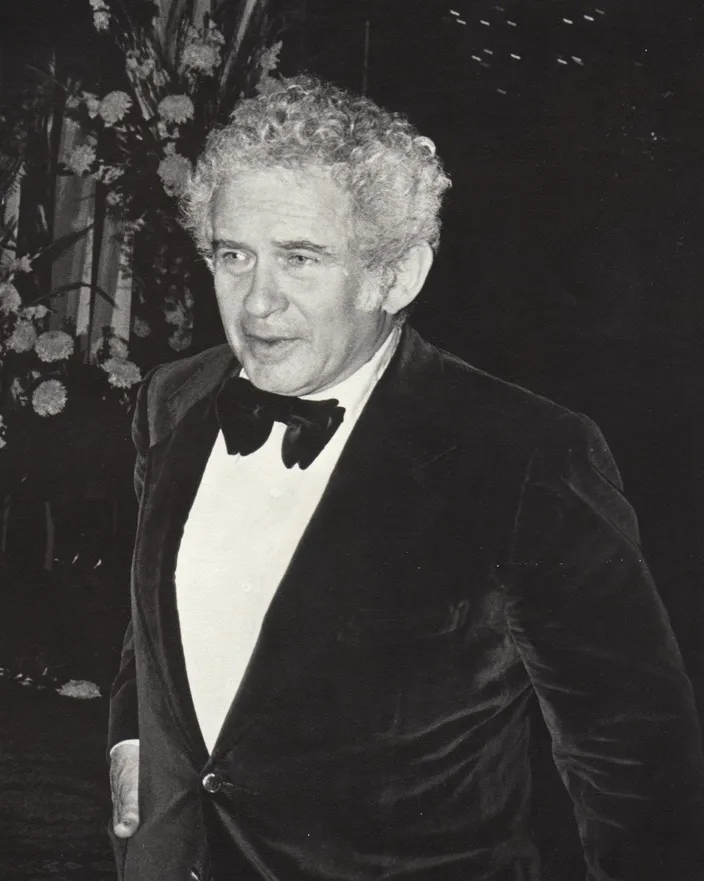
Winter–spring — the divorce, and a first reading
The year opened with the Boston courts and the long divorce from Beverly Bentley (79.2, 79.3, 79.5). In April, Norris Church gave her first major interview (79.4); on 6 May, at a Harvard Advocate benefit, Mailer first read in public from the book to come.
Summer
On 1 July, in Herbert Mitgang’s “Mailer’s Memory” (79.5a) in the New York Times, Mailer explained that he had left the William Morris Agency on his return from the war because his agent, Berta Kaslow, had left it, not over money or a grudge. In August Writer’s Digest printed Stewart Weiner’s “Where Nothing Is Felt” (79.6), a few of Mailer’s remarks on the writing life from a benefit talk for the Museum of Art in Provincetown.
Fall — The Executioner’s Song
15 October — Little, Brown published The Executioner’s Song (79.14), Mailer’s 1,056-page narrative of the Utah murderer Gary Gilmore, produced with Lawrence Schiller from over 15,000 pages of interviews — a “true life novel” that became his most acclaimed book in years. Joan Didion called it “an absolutely astonishing book” on the front page of the Times Book Review; it climbed to number three on the bestseller list and stayed twenty-five weeks, his longest run since The Naked and the Dead. The narrative had run in three Playboy installments (79.10, 79.19, 79.33), which won Playboy’s 1979 fiction award. The book carried Mailer through a marathon of interviews and tour appearances (see The Executioner’s Song), the best of them the Melvyn Bragg (79.26) and Buckley Firing Line (79.32) interviews. October’s interviews included Paul A. Attanasio’s “Talking with Mailer” (79.11) in the Harvard Crimson’s Fall Book Supplement, on the problem “of getting myself out of the book,” and Kenneth C. Davis’s “PW Interviews: Norman Mailer” (79.12) in Publishers Weekly (8 October), where Gilmore is “another major American protagonist.”
November — Jack Henry Abbott
In early November, Mailer met the convict Jack Henry Abbott at the Marion Federal Penitentiary in Illinois — the beginning of the association that would produce In the Belly of the Beast (1981) and end in tragedy. In December The Executioner’s Song was nominated for the National Book Critics Circle Award.
On 7 November John Leonard’s humorous article “Private Lives” (79.21) in the New York Times chronicled his relations with Mailer, and on 25 November Mailer joined the paper’s symposium of twenty-two writers, “The Books That Made Writers” (79.30), naming James T. Farrell’s Studs Lonigan, Rafael Sabatini’s Captain Blood, Jeffrey Farnol’s The Amateur Gentleman and the novels of Scott and Hardy. The November Harvard Advocate, a commemorative issue for Robert Lowell, carried Mailer’s letter (79.20) ahead of his portrait of Lowell from The Armies of the Night.
December
December 10 — U.S. News and World Report carries Mailer’s essay “Mailer on the ’70s — Decade of ‘Image, Skin Flicks and Porn’” (79.35), his views on the decade just ending: journalism, technology and the rise of the blockbuster novel.
December 15 — Mailer appears on Roy Plomley’s BBC Radio 4 programme Desert Island Discs, recorded during the Executioner’s Song publicity tour. The 40-minute career interview, Desert Island Discs: Norman Mailer (79.35a), is framed by his desert-island musical selections.
Related pages
- 1978 | 1980
- 1979 bibliography
- The Executioner’s Song (79.14)
- Desert Island Discs: Norman Mailer (79.35a)
- Gary Gilmore | Jack Henry Abbott | Lawrence Schiller
- Mailer: Poor Manager (79.2) | Battling Mailers Agree Norman's a Genius (79.3) | Norman Mailer: Warrior in the Battle of the Sexes (79.5) | Life with Mailer: After Four Years, So Far, So Good (79.4) | Mailer's Memory (79.5a) | Where Nothing Is Felt (79.6) | The Executioner's Song (Playboy, Part I) (79.10) | The Executioner's Song (Playboy, Part II) (79.19) | The Executioner's Song (Playboy, Part III) (79.33) | A Murderer's Tale: Norman Mailer Talking to Melvyn Bragg (79.26) | Crime and Punishment: Gary Gilmore (79.32) | Talking with Mailer (79.11) | PW Interviews: Norman Mailer (79.12) | Private Lives (79.21) | The Books That Made Writers (79.30) | Letter to the Editor (Harvard Advocate, Lowell issue) (79.20) | Mailer on the '70s - Decade of 'Image, Skin Flicks and Porn' (79.35)
Referenced by 31
Works
- A Murderer's Tale: Norman Mailer Talking to Melvyn Bragg
- A Special Message to Subscribers from Norman Mailer
- Battling Mailers Agree Norman's a Genius
- Crime and Punishment: Gary Gilmore
- Desert Island Discs: Norman Mailer
- Life with Mailer
- Life with Mailer: After Four Years, So Far, So Good
- Mailer on the '70s - Decade of 'Image, Skin Flicks and Porn'
- Mailer: Poor Manager
- Mailer's Memory
- Norman Mailer: The Champ of American Letters... (High Times)
- Norman Mailer: Warrior in the Battle of the Sexes
- Novelist Shelved
- Private Lives
- PW Interviews: Norman Mailer
- Talking with Mailer
- The Books That Made Writers
- The Executioner's Song
- The Executioner's Song (Playboy, Part I)
- The Executioner's Song (Playboy, Part II)
- The Executioner's Song (Playboy, Part III)
- Where Nothing Is Felt